
Muir to Forth


Project Background
Muir to Forth is a bold, landscape-scale restoration initiative inspired by the Knepp Foundation’s Weald to Waves model. The project aims to reconnect fragmented ecosystems across East Lothian, from the upland moorland of the Lammermuir Hills to the saltmarsh, dunes, and cliffs of the Firth of Forth, through a network of wildlife corridors linking nature-rich hotspots.
In its early development phase, Muir to Forth is focused on relationship-building, knowledge gathering, and mapping opportunities. We are actively engaging with landowners, farmers, and communities to identify areas with high potential for ecological connectivity. This collaborative groundwork is setting the stage for a transformative, long-term restoration effort.
Project Need
East Lothian is one of Scotland’s most intensively farmed regions, with over 70% of the land used for arable or pasture agriculture. While this landscape is highly productive, decades of field enlargement, hedge removal, and agricultural drainage have left much of it ecologically fragmented.
This fragmentation poses a serious threat to wildlife. Many farmland birds and mammals are in decline locally, including species like barn owls, kestrels, hares, and hedgehogs. Pollinators, crucial for the productivity of some of East Lothian’s agricultural outputs, are particularly vulnerable. Bees, hoverflies, and other insects need diverse habitats and connected foraging routes to thrive. Without intervention, their numbers will continue to fall, impacting both biodiversity and the long-term health of the farming economy.
Creating habitat corridors between existing biodiversity hotspots, from the Lammermuirs to the Forth, will support species movement, breeding, and resilience. Restoring this connectivity also delivers wider benefits: it supports soil health, carbon storage, and flood management; strengthens East Lothian’s rural economy; and enhances the well-being of communities by reconnecting people with nature.
Project Details
Land
East Lothian
Dedicated to establishing continuous nature habitat corridors from the Firth of Forth to the Lammermuir Hills to allow nature to thrive.
2025
Project Description
The Muir to Forth landscape restoration project was set up in early 2025 to address these challenges. It is ambitious in both scale, to cover East Lothian, and duration, based on a minimum 10 year vision. It has three main goals:
- To develop and enhance a nationally significant network of nature-rich ‘hotspots’ and habitat corridors across East Lothian.
- To highlight the value of nature in supporting vital ecosystem services that deliver clean water, fertile soils, pollinators, carbon fixers and flood controls.
- To support the development of healthy communities that deliver local green jobs and foster opportunities for people to enjoy, protect and benefit from nature.
As a charity Balanced Horizon is embedded in the farming and rural community of East Lothian. We firmly believe agriculture and nature conservation can co-exist side-by-side. We are starting to work with farmers and landowners using the principle of long-term ‘nature pledges’ to encourage the adoption of nature-friendly, regenerative practices that support biodiversity alongside maintaining profitable land-use operations.
Project Impact
Currently we are building relationships with key stakeholders across East Lothian including national government bodies to ensure we have a comprehensive picture of past and current activities in this area. This includes making contact with landowners in sites we see as offering ‘early adopter’ potential.
We are also creating a baseline set of information that defines the current status of biodiversity health and we will map broad clusters and corridors that build on existing biodiversity value. We will then reach out more widely to local landowners, farmers and community groups inviting them to engage with the project.
Our goal is to establish at least three core biodiversity corridors linking the Lammermuirs to the Forth varying in distance from 10km to 30km and covering an area of approximately 7,000ha (10% of area of East Lothian).

habitat improvement for key rare species – target 10 sites

10,000 acres pledged by 2027

15,000 trees planted by 2027

350 acres pledged – target 10,000 acres

habitat improvement for key rare species – target 10 sites
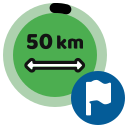
2 km corridor length committed – target 50 km

2 core landowners engaged with – target 20

8 core organisations engaged with – target 25
Project Supporters
Current supporter include:



The project is in its early stages and we are currently arranging discussions with a wide range of stakeholders from Scottish Government to environmental charities, landowners and farmers, and local community groups.
Project Further Detail
Long-term plans, short-term action
Initially our aim is to build a partnership of key stakeholders across East Lothian and create a baseline set of information that defines the current status of biodiversity health. From that we will define broad clusters and corridors that build on existing biodiversity value. We will then reach out to local landowners, farmers and community groups inviting them to pledge their support for valuing natural ecosystems when it comes to making key decisions about how to utilise their land assets.
While we have ambitious long-term plans, our practical delivery initiatives have already started. We are planning to bringing volunteers and local community groups together to support the planting of native woodland within John Muir Country Park near Dunbar following the damage it sustained during Storm Arwen in November 2021.
The goals of Muir to Forth are in full alignment with the UK Government pledge to protect 30% of our land and seas by 2030 to support nature recovery; the Scottish Government Biodiversity Strategy to 2045 (2023); and East Lothian Council’s Biodiversity Duty Report (2021-23), Improving Nature Networks for East Lothian’s Communities report (2023) and Nature Emergency declaration (October 2023).
The inspiration behind Muir to Forth lies largely in the work of other landscape-scale nature restoration projects in the UK, in particular the ‘Weald to Waves’ project in West Sussex run by the Knepp Estate Foundation. We gratefully acknowledge their generosity in sharing their experience to date with us. There is also a ‘Tor to Shore’ project in Cornwall.
Of course we take inspiration from our links to the world-renown conservationist John Muir who grew up in Dunbar and had a great deal to say about the value of wild spaces and their need for protection.
“Nature is ever at work building and pulling down, creating and destroying, keeping everything whirling and flowing, allowing no rest but in rhythmical motion, chasing everything in endless song out of one beautiful form into another.” Our National Parks, John Muir, 1901
Want to become a partner, sponsor or volunteer?
Join a growing network of changemakers helping to protect and restore our natural world. Whether you’re a business, organisation or individual, your support can help us go further, faster – and make a lasting difference